

spiritual insight : ค้นหาหนังสือธรรมะ หน้า 6 / 15
หน้าหนังสือทั้งหมด
202
The Significance of Donating Buddha Images
examine this so that we will not miss the opportunity to do so.
We should clearly understand the importance of contributing
a Buddha image so that we do not obstruct our grandparents
when they wish to
This text emphasizes the importance of donating Buddha images as a means of showing gratitude towards the Lord Buddha and contributing to spiritual merit. It discusses the concept of Bodhisattas, indi
113
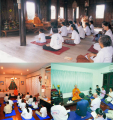
Buddhist Meditation and Spiritual Activities
The image contains three pictures, each depicting people involved in religious or spiritual activities, probably in a Buddhist setting. The text content is not visible or is not the primary focus, but
This content showcases three images capturing the essence of Buddhist spiritual practices. The top image features a monk leading meditation on a raised platform, guiding a group seated on mats in a tr
95
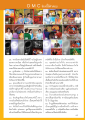
Exploring Spiritual Imagery and Meditation
1. (Images of Buddha, meditation, natural scenes, and traditional textiles)
2. (Images of women interacting, people at a temple, and group discussions)
3. (Black and white images of planets or moons,
This content presents a compilation of images symbolizing spirituality and meditation, encompassing depictions of the Buddha, natural settings, and traditional textiles. It features women engaging in
50
Understanding the Connotation of Dhamma in Relation to Brahma
In the case that ‘brahma-’ refers to the masculine ‘Brahma’
In case of the term ‘brahma-’ in the three compounds50 being
translated as a masculine ‘Brahma,’51 the comparison of the first and
the third
In this text, the term 'brahma-' is analyzed in the context of its translation as the masculine 'Brahma.' It discusses how the comparison between the Tathāgata and the Brahma, the creator, illustrates
82
Interpretations of Dhammakāya in Pali Commentaries
In addition to the above two commentators, Upasena and Buddhadatta141 are also Pali commentators who lived around the same times.142 Upasena agrees with Buddhagōsha in regard to his interpretations of
The text discusses the interpretations of the term 'dhammakāya' by various Pali commentators, focusing on Upasena and Buddhadatta, who align with Buddhagōsha, and their views on the Buddha's qualities

46
The Significance of Giving to Spiritual Seekers
"By giving a gift to one who has entered upon the way to the realisation of the fruit of stream - entry, the offering may be expected to repay incalculably, immeasurably.
What, then, should be said a
This text examines the immense value of giving to those who are on the spiritual path, highlighting the exponential returns of such acts. From stream-enterers to Tathāgatas, offerings made to these en
47
The Journey to Enlightenment: Sodh Chandasaro's Transformation
PHRAMONGKOLTHEPMUNI 43
the beginning of the path to spiritual attainment. He was overjoyed. Even the midday meal tasted extraordinary delicious that day. He looked forward to continuing a long medit
In this text, Sodh Chandasaro embarks on a profound meditation session, making a resolute vow to attain enlightenment similar to the Lord Buddha. As he meditates in front of the main Buddha statue, he
163
Understanding Pali and Parami in Buddhism
Pali: an ancient language used in India, now no longer an active language. The original Buddhist scriptures were written in Pali. Pali texts are used by the Theravada school of Buddhism.
Parami: a Pa
Pali is an ancient language from India that is no longer actively spoken but holds significant historical importance as the original language of Buddhist scriptures. These scriptures serve as a core e
7
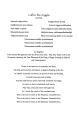
Call to the Angels - A Chant for Protection
Call to the Angels
(In Pali)
Samantā cakkavāleṣu
Saddhammam muni-rajassa
Dipe rathe ca gāme
Bhummā cāyantu devā
Tīṭhantā santike yang
Dhammassavanakālo ayambhadantā
Dhammassavanakālo ayambhadantā
Dham
This text serves as a call for the celestial beings (devas) from around the galaxies to gather and listen to the recitation of the True Dhamma, which is believed to lead to spiritual liberation. It em
125
Understanding Kamma and the Importance of Intentional Action
Suzanne Jeffrey
"Kamma, then, applies to body, speech, and thought: action with intention. And the actions that we perform throughout our lifetimes reflect negatively or positively on the people arou
Suzanne Jeffrey discusses the significance of Kamma as it relates to body, speech, and thought, emphasizing intentional action's effect on relationships with family, teachers, and spiritual leaders. T
59
Publications and Media of the Dhammakaya Foundation
PUBLICATIONS AND MEDIA
As the demand for teachings on the culture for inner peace becomes broader, the need for academic resources for study of the culture, especially media resources has become grea
The Dhammakaya Foundation has recognized the growing demand for academic resources on inner peace culture. Committed to producing teaching materials including books and multivision presentations, they
14
The Importance of Ordination in Buddhism
Ordinal is an essential part of life for all male Buddhists. The individual cultivates merit that carries over into the next life and receives many benefits for his present life. Furthermore, he gains
Ordination is a fundamental aspect of life for male Buddhists, as it allows individuals to cultivate merit that influences both their current life and future existence. In addition to spiritual benefi
45
The Importance of Moral Education in Teaching
Only with moral education can human beings eliminate conflicts, selfish and greedy tendencies and practices so that man may truly coexist with mindful and peaceful consideration for each other. This s
This text emphasizes the necessity of moral education to eliminate selfish and greedy tendencies, enabling peaceful coexistence. It discusses the role of various types of teachers—parents, school teac
28
DhaKma: Your Path to Self-Reliance and Prosperity
DHAKMA IS YOUR REFUGE
I see all the way through. I see clearly that, out of everything in this world and beyond-physical, natural, and spiritual- no one can help me but me.
Who else can relieve my suf
In this text, the author emphasizes the importance of self-reliance and personal responsibility in alleviating suffering. By turning to Dharma as a refuge, one can navigate life’s challenges. The key
37
Lessons from Khun Yai: Embracing Life and Death
27. COME TO THE TEMPLE NOW
Khun Yai encouraged those who came to the temple for the first time to visit the temple often. Whether it’s early or late in life, we all end up in the temple one way or ano
In these teachings, Khun Yai emphasizes the inevitability of visiting the temple, especially regarding death and the afterlife. No matter our life stage, we all will face the consequences of our actio
84
Embracing Virtue and Avoiding Harm
124. GRAB THE FLAG OF VICTORY
We are extremely fortunate to be born a human being. We are born to pursue
virtue, to build spiritual benefits. So take this opportunity to accumulate only
good thi
This text emphasizes the importance of being human and the opportunity to build spiritual assets through virtue. The author shares personal experiences of adhering to the Five and Eight Precepts, disc
70
Understanding Buddhism: A Cosmic Religion
BUDDHISM
‘The religion in the future will be a cosmic religion.
It should transcend a personal God and avoid dogma and theology.
Covering both the natural and the spiritual, it should be based on
Buddhism, founded by the Buddha over 2,500 years ago, emphasizes freedom from suffering and is based on logical, practical principles. This religion transcends blind faith and superstitions, making it
5
Meditation and Enlightenment
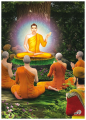
There is no visible textual content in the image to extract with OCR. The image depicts a serene scene of a monk or spiritual teacher sitting cross-legged in front of a decorated figure that appears t
This image captures a moment of tranquility where a monk shares wisdom in front of a decorated figure resembling the Buddha. Several monks-in-training absorb the teachings, reflecting the essence of s
96
The Structure of Merit in Buddhist Practice
If the alms-giving involves contributions made toward the building of a consecrated assembly hall, a shrine hall, a preaching hall, or a Cetiya, this part will be huge.
Part 2: This is the middle par
In Buddhism, the concept of merit manifests through a symbolic castle structure, divided into three parts: the base formed by alms-giving, the middle by observing precepts, and the top by meditation p
42
Kala, Anathapindika's Son
3
KALA, ANATHAPINDIKA'S SON
This instruction was given by the Teacher while he was in residence at Jetavana with reference to Kala, son of Anathapindika.
Tradition has it that Kala, although the s
This teaching illustrates the challenges faced by Kala, son of the wealthy Anathapindika, who remains indifferent to his father's guidance and the teachings of the Buddha. Despite his father's attempt